Meet the Founder
Conscience-Driven Leadership™ is a leadership architecture developed by Hanna J. Miller.
This page tells the story of where the work came from.
Where I learned leadership
I didn’t learn leadership in business school or inside corporate hierarchies.
I learned it in the circus.
I spent twenty years in live entertainment, starting as a performer at age eleven and moving into senior leadership in my early twenties. By my late twenties, I was helping run a 365-day operation: five hundred shows a year, sixty-five horses, a full cast of humans, and a thousand meals served per performance.
This was more than a spectacle. It was logistics, safety, timing, and trust under pressure.
When accountability lagged, people got hurt. When words and actions diverged, risk escalated immediately.
Leadership couldn’t be about style - it had to be about safety.
what pressure taught me
During the 2008 financial crisis, I was responsible for cutting the company budget by twenty-five percent - roughly $3 million dollars - while the operation continued, as it always did.
The show must go on wasn’t a slogan, it was our baseline.
My question was simple but relentless: How do we do this better and cheaper?
Not cheaper by cutting corners, but cheaper by cutting waste, because inefficiency is expensive. It burns money, yes, but it also burns people. Without structure, clarity, or boundaries, stress becomes the currency.
By redesigning how our circus operation actually worked - not just trimming it - every major metric improved at once: engagement, retention, guest experience, quality. Accountability moved faster, roles were clearer, and most importantly, trust stabilized.
That was my first sustained lesson in what structural trust makes possible.

When capacity outgrows its container
The circus was also my family business, which meant conflict wasn’t just professional…it was also personal. My boss was my dad. When we clashed over vision, values, and control, I absorbed the friction so my team could keep functioning.
Eventually, it became clear that our misalignment wasn’t about effort or skill - it was structural.
I realized I wasn’t ever going to thrive in that environment, even though it was the only one I’d ever known. The conditions didn’t work for me anymore. The only way to stay meant abandoning my principles and shrinking to fit into a system where I didn’t belong.
So I left, walking away from the only job I had ever known and, from an identity that had been forming since childhood, because sovereignty mattered more to me than familiarity.
the patterns that wouldn’t stop repeating
After that, I began working with leaders in other systems. At first, people assumed I should take executive roles, but after a few interviews, I understood something about myself just as clearly as I had understood the circus: I don’t do my best work inside hierarchies.
Instead, I do it alongside leaders, where real thinking can happen without performance, politics, or protection.
I have an uncanny ability to read human dynamics, and to anticipate reactions, resistance, and downstream consequences before they surface. That capacity isn’t mystical - it’s simply pattern recognition, honed in environments (like the circus) where guessing wrong meant paying a price.
Across sectors - nonprofits, higher education, small businesses - I kept seeing the same dynamics I had lived with for decades:
Leaders carrying responsibility that wasn’t theirs.
Trust eroding because accountability lagged, not because people didn’t care.
Systems rewarding avoidance while punishing clarity.
And ultimately, capable, conscientious leaders exhausting themselves trying to compensate for structural failure.
The Work that Emerged
I didn’t set out to create a framework - I just named what I kept seeing because not naming it was expensive.
“Trust Physics” - a way to describe why trust behaves predictably under pressure and why accountability has a speed - came first. Conscience-Driven Leadership followed as an architecture, not an ideology; it became a way of making visible how certain leaders already operate, often without language, support, or permission.
I’m not interested in polishing perfect leaders. Instead, I help real leaders navigate high-stakes, human systems with clarity and structure, and stop paying for systems that refuse to evolve.
How I live
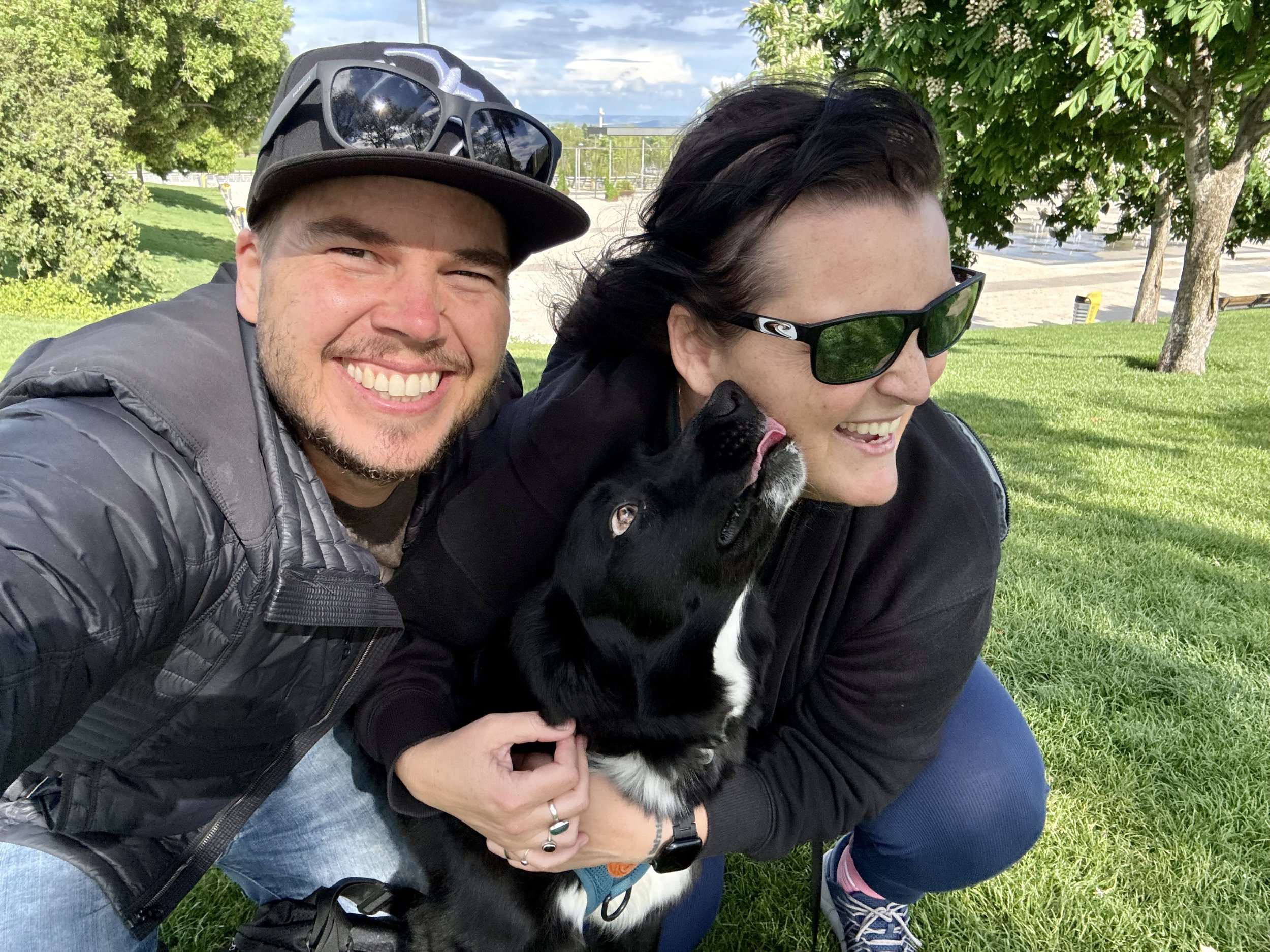
I live in Spain with my college-sweetheart-turned-husband and our too-smart working Aussie, Thora. We’re close enough to regularly visit our families in Norway and Germany, and far enough to stay warm in the winter.
When I’m not working, I knit, cook simple meals, and keep stumbling my way into Spanish (which I’m loving more than I expected). We live in the Valencian Community, where fiestas unfold right outside our building, fireworks punctuate ordinary evenings, seafood and tapas are less a treat than a daily staple, and our unlikely best friends here are a pair of Scouse women who keep us laughing and grounded.